Un moș și-o babă
In the beginning there was...

…a geezer and a crone. A senior citizen and an old lady. This is the underlying principle of it all hidden in every folk story intro. Once upon a time, there was a grandpa and a grandma. They are the two eternal poles that survive and witness the changing cycles. The two natures. The Sun and the Moon. Anthropomorphized. Starting point for all this series btw. An Old Man and an Old Woman. Sounds less convoluted in Romanian.
This is part of a yearlong series on the second edition of Colière, the Euclidian Non-Isochronous Rhythms card deck. Each card is a pretext to gloss over one item of Romanian mythology, anthropomorphize it, all aimed at easier visualizing and audiating one particular rhythm.
Today it’s about “Un moș și-o babă…”.
Following this pair throughout folk tales, we can trace its evolution.
…the ancient and ageless pair appears in different guises, but in all as witness to the fairy tale's career, in reality conditioning it, as I said. In its purest, most traditional guise, it manifests in The Tale of the Pig. In The Pouch with Two Coins, the pair is divided, not at war, but hostile, each of the two terms having its own household; it's a kind of Manichaeism that divides the universe into two antagonistic camps, through forgetting the common principle. It is a cyclical disorder. To make a schema, the "old man" emits the Rooster, and the "old woman" all the hostile forces that try to destroy his work of solar and virile restoration. The expedition is carried through to the end. The disorder is much more serious in The Old Woman's Daughter and the Old Man's Daughter. Not in two households, but in one the war is unleashed; in reality the old woman's tyranny is quasi-permanent until the intervention of the providential element that strikes like lightning from a clear sky and where you least expected it, as in any soteriological myth. Femininity almost totally overwhelms masculinity, as in the time of the Amazons. But still a woman restores the dignity of her sex, the Old Man's Daughter. In The Tale of the Pig, the pair of old people has an entirely positive value, at the highest level of their symbolism, which is harmonic and complementary. The old man and old woman are the adoptive parents, the "raisers" of Făt-Frumos as Creangă calls them, with an alchemical nuance of "multiplication," of "prosperatio," in the fulfillment of the "Magnum Opus." They are the adoptive parents not only of the "Avatar," but of the entire cycle.
— Vasile Lovinescu in Creangă și creanga de aur
TLDR: during three separate tales, it goes from harmonic and complementary to femininity overwhelming masculinity.
In the story of the mother-in-law, she has three sons, “strong, virtuous but weak minded”. In turn, the heavenly masculine has three axis, corresponding to the three gunas, Sattwa, Rajas and Tamas — upward, sideways and downward. Only when the three sons are matched with the three daughters-in-law they '“activate” their corresponding principles. Here we don’t even see or hear anymore from the old man. It’s just the hag ruling the world. She is not explicitly the same old woman from the primordial pair, but it can be interpreted as such. A step further down. For more on that story, I translated Vasile Lovinescu’s commentary here:
The Jealous Mother (is sleepy)

This is the first folk tale by Ion Creangă tackled by Vasile Lovinescu in his volume “Creangă si Creanga de Aur”. Vasile Lovinescu was a Romanian Traditionalist critic and philosopher, and here he is discussing the hermeneutics of Creangă’s folk tales. First published in 1989, with a second edition in 1996, it was not yet translated into English apparen…
Returning to the instances where we find both of them,
[…] the primordial couple suffers vicissitudes resulting from the imbalance of the ambient nature and, in other words, in turn this imbalance of the primordial pair increases that of nature. The nature of the relationship between the two factors determines the harmony and good economy, not only of society, but of the entire plane of existence. When the pair appears under the aspect of opposition and extreme antagonism, it secretes chaos; when it is harmonic, it becomes complementary, with the finality of spiritual and physical generation; we have a relative equilibrium, as much as is possible in the kingdom of life and death; in eschatological perspective, that is of the end of Times, the pair is reabsorbed beatifically into Unity, returning to the Androgyne from which it proceeded. We emphasize what we said at the beginning: besides the pair Adam and Eve and their posterity which is generated from generation to generation, there also exists, transcendent, the primordial pair Purusha-Prakriti which is present and watchful throughout the entire cycle, but not through reproduction, but through privation of death, old because it has never lived and therefore never dies, not physical parents, but spiritual parents of humanity, its “guardians,” the Old Man and Old Woman of the Cycles or, more simply, as they are called in our fairy tales, the Old Man and the Old Woman. In pure state we find them in The Pouch with Two Coins and in The Tale of the Pig, that is without physical posterity, precisely to distinguish them from the Adam-Eve couple and to emphasize the functional differences. When they have children, as in The Old Woman’s Daughter and the Old Man’s Daughter, it is not so much in the sense of a human posterity, as for the necessity of “exteriorizing” their interior powers, their specificity, with a view to action in the world. In other words the children are their Shakti. Likewise, we must not let ourselves be deceived by their apparent weaknesses, by their discord, in some fairy tales. Their discord is “functional,” it is an ordeal destined to create in the world disharmonies necessary for the “liquidation” of the cycle. How could a humanity hasten toward its end, with a view to resurrection, if partial imbalances did not occur whose ensemble constitutes a total equilibrium?
— Vasile Lovinescu again


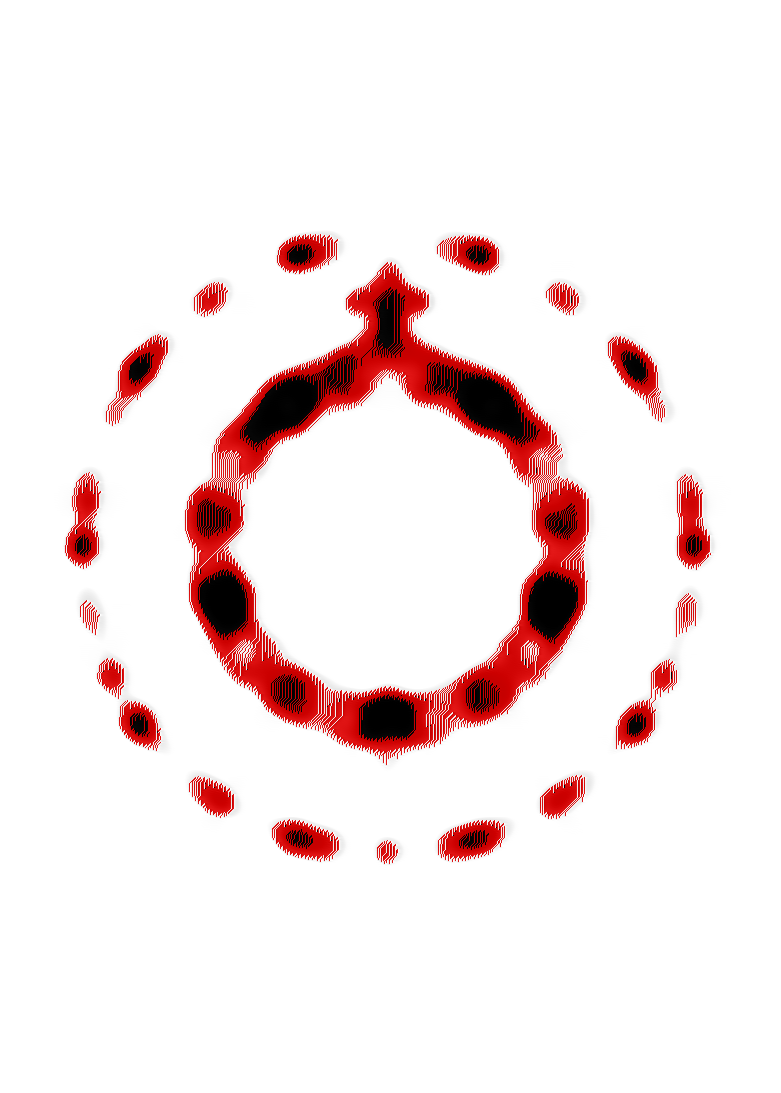
So they both had to be featured together on the only card without a pair in this deck. They are both within in equilibrium. One and two. In Coliere V1 it is OINOS, E(1,2). The oldest PIE word, the root of it all, The One. [x .] It’s not limping at all. Steady. Containing all the potential expressed in the others, condensed. One pulse, one pause. Relentless. Familiar. Ancient. Primordial.
Ba-[.]
1-2
I had planned for this couple to do a Celebrity Death Match Special featuring two authors from the 1960s as the Old Man and the Old Woman, but I took the “quoting V.L. shortcut” as it’s so on point, so I might return to it in a future standalone article. Maybe next week. What’s beyond this One pair? What’s the earth in which it germinates? Maybe it will be a series. Until then, Pustia E(5,9) comes next.
.