Colière
I made a collection of rhythms in the shape of a card deck

I ended my pretentious history a few months ago with a few possible paths forward.
Plan to build a lexicon of sonic symbols matched to Romanian folk stories
Study traditional rhythms beyond standard 4/4 beat
Goal of creating a “sonic praxis” that is both rebellious and reverent
Aim to develop fluency to tell stories through coded sound
Exploring adding traditional instruments
I went on with number two, having already some idea about the work of Godfried Toussaint1. Reading his paper, I noticed many Balkan references and mentions of one Constantin Brăiloiu. So this is something close to home, of which I had no idea it existed. Basically, Mr. Toussaint connected Euclidean geometry to ancient folk rhythms. He gives some examples in there, but those are so foreign to me, I had to dial stuff up into a drum machine to read them for me. I recorded a bunch of them, then played them into my headphones on shuffle, just to see if I get to befriend them. Later I found out that this is called audiation and it’s the best way into musical patterns according to Edwin E. Gordon. And then I started noticing other patterns while immersed in patterns. I’ve seen the big picture, like a map where each one had its right place.
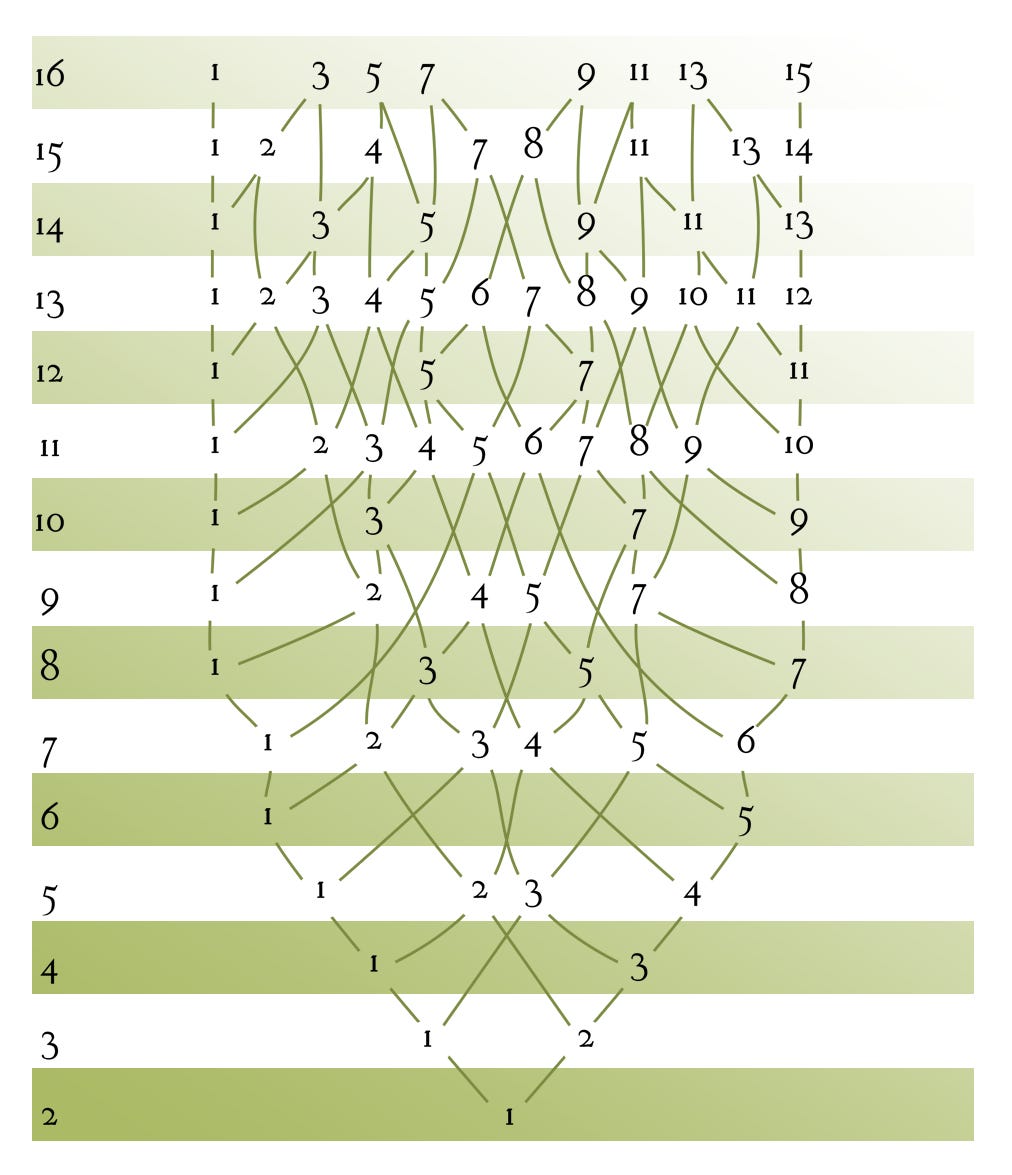
I began to see this Tree. Climbing up patterns grow longer. From left to right they grow denser. The sparser half represents the Masculine principle and the denser half the Feminine. Maybe it’s the same spectrum that Rurik speaks of:
Mysticism on one end and Moralitarianism on the other.
Mysticism ←—————→ Moralitarianism — Rurik Skywalker / GMC-IV
Might have been more accurate if I had the Masculine on the right side and Mysticism on the left, but we write from left to right, so.. that’s it. Look through a mirror2. And on top of that, Dmitry is right in saying that the dosage makes it so.
These are dyads. Friendly foes. Synergistically antagonistic. Adversarially complementary. Symbiotically combative. — Dmitry / BF-I
Anyway. I had to make cards for all of them. A deck of cards. And it should be accompanied by a booklet just like Chase Bliss has the nice little booklet for each pedal (and I admire so much). In order to illustrate it, each rhythm will be a number of elements on a circle. Euclidian rhythms are k elements in n slots, as evenly distributed as possible. Like k knights sitting around a table with n chairs. But I filter just for the pairs of relative prime numbers. Non-isochronous. So nothing divides evenly here.
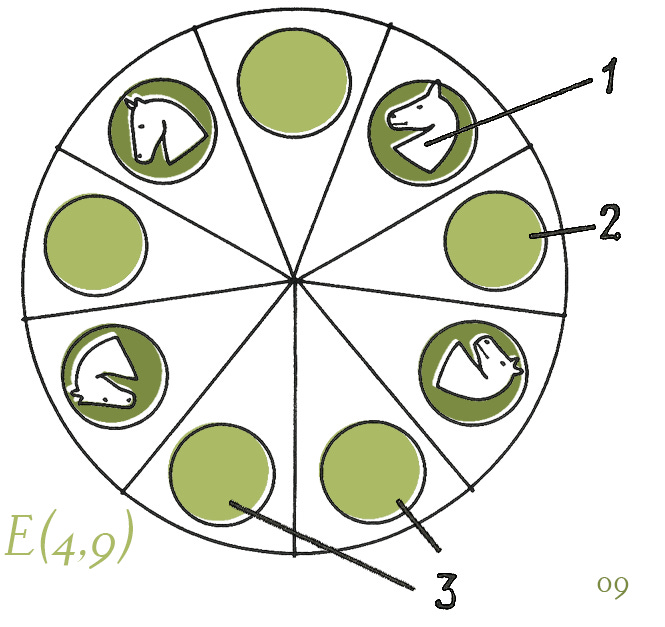
So the deck has every possible arrangement for tables sized 2 through 16 chairs, 78 unique Euclidian patterns, plus one extra card without a pair for the primordial E(1,2) beat. Coincidently, the Minor plus Major arcana of the Tarot also have 78 cards. I’ve tried to match them, but I’m not as familiar with the tarot to do the job. I made my own system instead.
Four realms of complexity crossed with twelve families.
Starting with the shortest patterns, they are four groups corresponding to the four elements. Fire, then Water, then Earth, ending with Air, the longest.
On the other “axis”, some short rhythms had clear correspondents among the medium and longer ones, sharing the same type of pattern. These will form the families. And each family has its pair, because of dyads. Worldbuilding. It was fun naming and finding one suitable heraldic element for each one.
“Change the language!” — Phoenician Hunter
I named all the families in Latin. And then, I needed names for each card. Something to represent that rhythm, to help memorize it, to fit in the broad elemental category, and also to make a good pair with its dyad. On top of that, 4 elements / 4 languages. Fire is Latin, water is Greek, earth is Russian and air is Romanian.
Some pairings make sense immediately, while some are a bit stretched, in need of extra justification. For example, I had to have one Turkish word in there, as many of these rhythms supposedly came to the Balkans with the Ottomans. Or, it’s hard to explain how Throne is paired with Fermentation and (to) Quiver with Firestarter. I see this naming convention as a skin that can be swapped with another3 one at any time. It’s temporary. A placeholder. But it might stick. Especially as I catch myself treating it as a completed work for now.
I will not elaborate any further
While I was at it I had so many things to say about it and now that it’s done there seems there’s not much to add. Apparently it’s true that action speaks louder than words. It’s that kind of thing that should not need much explanation and theorizing. I also read in one YouTube comment that [famous Romanian] used to tell his students that you should read everything by [famous Frenchman] but never mention it to anyone.
A great work of art opens up a ‘magic window’. It shows you a glimpse of the treasure beneath the ground, which makes you understand something new and important about “reality”, establishing the ethos of a people (World). At the same time, it reminds us that the treasure is still hidden—there is just as much mystery and darkness left in the dirt (Earth). This dynamic tension, this existential strife, will always be present since there is no such thing as “objective Truth”. Reality is an endless game where what can and cannot be seen is eternally revealing and concealing itself.
Aristocratic Dog — Against the RETVRN


Also showcased here, alongside with the “audiation aides”.
Up and down could also be reversed, if unity is to be above multiplicity, but then there is no tree. Might be the roots.
Version 2.0 should feature some snakes on the Mystical side, opposing the eagle. For now the Tree in that illustration looks full of snakes, so there you go.
Wonderful idea, and a beautiful execution of it.