Paparuda
The Thracian Bucket Challenge

This is part of a yearlong series on the second edition of Colière, the Euclidian Non-Isochronous Rhythms card deck. Each card is a pretext to gloss over one item of Romanian mythology, anthropomorphize it, all aimed at easier visualizing and audiating one particular rhythm.
Today it’s about “Paparuda”.
She is at the center of a rain making ritual. They say it used to have a fixed date of celebration around the spring equinox as many others, but was pushed later towards summer when Easter arrived in the calendar, and finally ended up as an “on-demand” service in case of draught.

She is appearing all across the Balkans, up to the eastern Slavs. The theory is that she was Thracian when the Slavs arrived and assimilated her. The name is said to relate to Perun, but also with Rudra. She is supposed to be Perun’s daughter. Her mother was Dodola. This is allegedly a Thracian name, tracing her to the previous dwellers of these places. If I learned anything from Witia, is that all these modern telling of more often than not reconstructed Slavic gods and goddesses are to be taken with a grain of salt. As everything else that is so old and has passed through the long telephone game of history.
Mihai Dragnea wrote this short paper on Paparuda being Thracian, it’s here for free. It has pictures. Of semi naked pre-teen girls. Well, covered in leaves.
So depending on the exact location in the Balkans, they take a young girl, rarely a boy, dress her in leaves and parade around the village dancing and singing a particular song, summoning the divinity to bless the families with rain, and good crops. She received gifts, food and drink from the people, that’s why usually they picked a girl from a poor family, to also help them out in the process. In other places she is a Gypsy girl. Some things pre-Christian now being seen as pagan and malefic were transferred to Gypsies, the Other, the designated scapegoats, taking the roles of witches, fortune tellers, spellbinders. They tried to ban the custom since the 1700s, just like they still ban customs these days. The gypsy did it for the money, got even more shade, accentuating existing tensions.
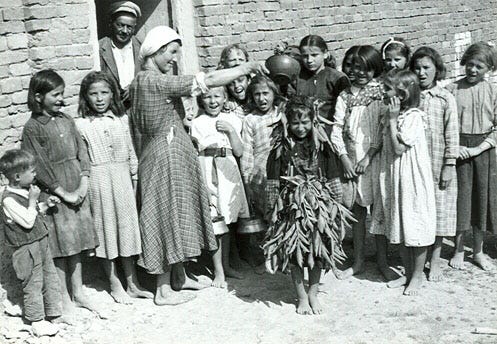
This girl, usually around 10 years old is dressed in this plant costume, and being followed by all the other kids runs around the village. First she was naked covered more or less in leaves, then it got to having just a couple of leafy branches tied over her clothes. The mother of each household welcomes her by dropping a bucket of water on her. Or alternatively, she splashes water on the other people present. Basically it’s a little water gun fight before water guns. People get wet, laugh and sing, and then take Paparuda back to the place they dressed her up, near a river maybe, undressing her of the foliage. This is representing the dying part of the ritual, looking at the leaves floating away down the river. Then they feast on whatever bounty they’ve got.
It mirrors winter’s Sorcova in the summer. Another vegetal female character touring the village and getting treats.
Sorcova [EN]
![Sorcova [EN]](https://substackcdn.com/image/fetch/$s_!bISQ!,w_280,h_280,c_fill,f_webp,q_auto:good,fl_progressive:steep,g_auto/https%3A%2F%2Fsubstack-post-media.s3.amazonaws.com%2Fpublic%2Fimages%2Fc922831f-e37f-4524-a89e-6e7edb7fe5df_3125x4375.png)
Paper flowers on a stick. You tap it against a window or on someone’s shoulder. Those rhymes are sung like an incantation.
The disguising as a phytomorphic goddess (the wearing of plant costume) of persons different in sex and age, often for profit (by Gypsies), the change of a fixed holiday with a mobile one and then an accidental one (at the appearance of droughts), the adoption in Transylvania of the names of other agrarian customs and ceremonies (Burduhoasă, Mătăhulă) are atypical elements which express the dissolution of belief in the power of Paparuda to unleash the rains. — Ion Ghinoiu, Dicționar de mitologie româna, 2013)
Another one bites the dust, as they say.


This one is named ἘΚΒΟΛΉ (Outpour) in the old deck. It means more like discharge, throwing out dead weight, casting out what’s no longer needed. Pouring out water as if it’s no longer needed precisely in times when it’s needed the most. Emptying the bucket on that little Paparuda, for her to summon even more water for the fields. Nine straight pulses and a respiro.
Pa-pa-ru-dă, ru-dă, ne u-dă!
1-2-3-1-2-3-1-2-3!