Iama
[I am a]n Indo European.

A legal alien. We have an Indian deity among us. Or more likely we and the Hindus have common deities, that originally came riding from the steppe and subsequently became gods for them, and folk spirits for us. Certainly the ones present in the Vedas. Indra, the blond one, is weaponizing thunderbolts just like Zeus, so there must be others too. We also have a Rudra instance here, rain related.
In Indian mythology, Trimurti consists of Vishnu, Shiva, and Brahma. In Serbian mythology, Triglav consists of Višnji, Živa, Branjanj. — OEC
The Slavs have even more, so that’s likely that they were the middle man. Some are Fake-lore. But underneath the diversions and fakes there are the real ones. There must be. It’s more fun.
Sifting through these ancient myths, we are left with the fragmented memories of an ancient war. Conspiracy theorists have had a lot of fun with the Vedas over the years. - Rurik on Eagles and Thunderbolts
In Hindu iconography Yama has four arms and “the complexion of rain clouds”. So they drew him dark blue. In more realistic terms chances are he was not that blue, and he certainly was not dark-skinned in the sense the other Indians were dark-skinned. The ones that became more prominent later, like Vishnu, have a “divine blueness”, representing maybe something else. Yama had grey-looking, desaturated skin color.
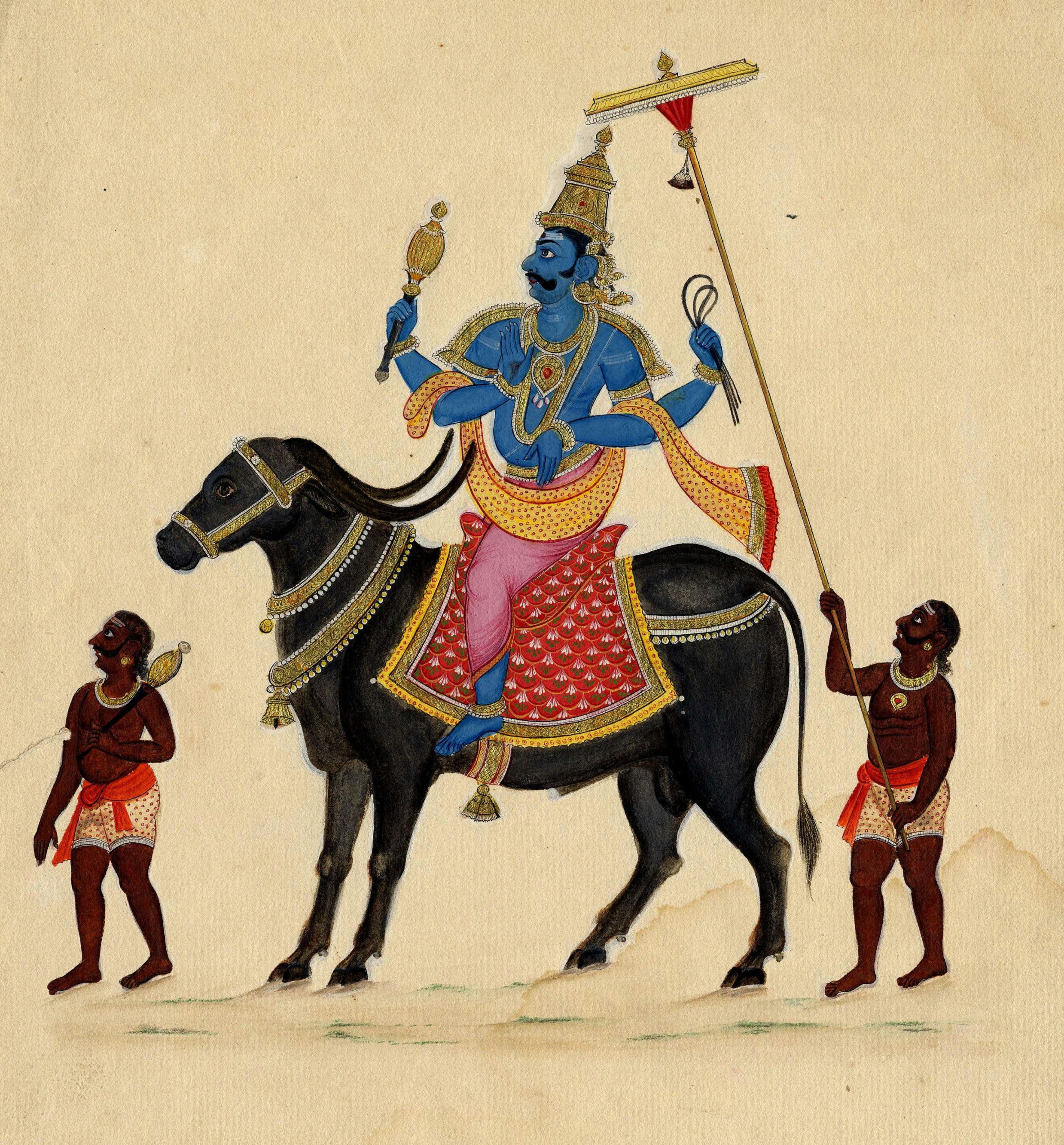
I don’t know if the Russians really wrote the Gita, but there is something there. Asha Logos goes into the whole Aryan connection:
James Henry Breasted noted the Mitanni’s interactions with Egypt and Hatti, suggesting their kings’ Indo-Aryan names and deities indicated an Aryan elite, part of the same wave of Indo-European movements that influenced Anatolia and India.
Anyway, Yama was the first man to die, so he received the honor of being the god of death. That’s why he has a noose, to catch souls.
Our guy Iama, with an ‘I’1, is less important in our pseudo-divinities list than Yama is in the Hindu one. Not that Yama is anywhere close to being a main character, but still. Iama is still responsible with death, but he is concerned only with animals and plants. We have plenty others to take care of the humans. Indeed, in the Coliere system of dyads, Iama’s pair is another death-bringer, Corboaica. She is the busy one (11 in 15), and Iama is the sparse, chill counterpart E(4,15).


In Coliere V1, this is Potecă (Path), steady 4 beats pace until one slightly quicker closes the loop. It’s a sparser version of Călușul. Hard to differentiate between the two, it seems it’s just a slower version, but not quite. It’s handy to use Corboaica as a mental cue, and stomp or clap once every cluster of beats. Borrow her mantra, keep only its spine.
MOrrigan, MOrrigan, MOrrigan, KRA-kra!
They complete each other. Corboaica takes Yama when he dies, Iama takes the raveness when she dies. One hand washing the other.