Cocoșul
Here... they come to snuff the Rooster, aw yeah!

It got replaced by the alarm clock many years ago, but you know he ain’t gonna die! Apparently, the first crow marks midnight, the second is three hours before sunrise, when many crows can be heard again, and you can say it’s the third one. Three times, three crows in the dark and then comes the day. Or so they say.
Anyway, who exactly are they, who came to snuff the Rooster? This time it’s not about them.
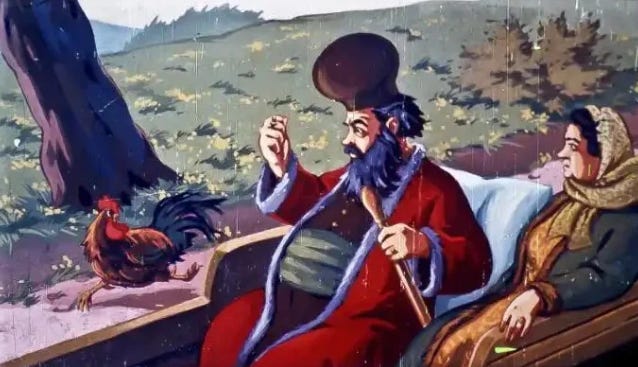
Might as well be the one and the same but nevermind. Actually I have another issue with what’s depicted here. While browsing through old and new illustrations for this fairytale, I found none depicting the boyar in the carriage together with a few fancy ladies as in Ion Creangă’s telling of the story. He is instead shown either by himself with the coach driver or as in the one above, with his supposed wife. It does matter because the ladies are representing the feminist amazons rebelling alongside the warrior boyar against the priestly Rooster. Let me back up. I will paraphrase and quote Vasile Lovinescu commenting on “Punguța cu doi bani”1
The Rooster is a Solar symbol of Atlantean origin as all other fiery and luminous symbols together with their Lunar counterparts. Sun and Moon, Rooster and Hen, Phoenix, the Waters. All of these were preceded by the Hyperborean Primordial Tradition, as the Boar, the Bear, the Swan, the fir forest, all of them wild, silent, polar.
As the story goes, once upon a time there was an old man and an old woman. He had a Rooster and she had a hen. The hen laid eggs, and the woman wouldn’t share with the man. This hints at current feminism as being just another echo of a long and ancient feud. The split is marked here by the sterility of the hen’s eggs, that end up being eaten by the old woman, never getting a chance to pass into a living thing. Guenon speaks of this, alluding this Amazonian subversion originated before the demise of Atlantis, but that’s a story for another time. The Rooster gets beaten, but still won’t lay eggs so he goes on a journey. He finds this “two coins in a sack” on the road and then a respectable business man with his lady companions passes by and snatches the sack from the Rooster.
…the pouch with Sun-Moon, polarization of a single principle, encompassing between its extreme terms all the wealth of the world, all the possibilities of the cycle, an inexhaustible source and horn of abundance of material plenitude, but especially spiritual. The small pouch with two coins (of gold and silver) is also the alchemical Athanor, containing the two fundamental complementary principles, prerequisite to any attempt at transmutation. The Magnum Opus begins with "the struggle of the two natures" in a closed vessel, purifying one through the other, until the elaboration of a common limit which is the Prima Materia. Essentially, the pouch synthetically contains what the Old Man and the Old Woman represent in the Macrocosm, namely the primordial couple Purusha—Prakriti, whose "natures" the Rooster will "rectify" and coordinate anew.
Don’t steal a cock his sack. So the Rooster goes on to pester these guys asking for his sack back. And now the story matches the Jerry Cantrell Sr.’s story, because here indeed they come to snuff the Rooster. And just like the mighty Vietnam vet,
…he ain’t gonna die
No, no, no, he ain’t gonna die.
He is passed through Water and absorbs it, through Fire and he extinguishes it, to the Earth where he eats up all kinds of livestock, and also gets to liberate the Solar Gold from the depths of this guy’s treasury, swallowing all his cash. In the end the successful businessman gives up, returns the sack clueless to its true value, and as the Rooster is heading home satisfied is followed by all the poultry and other birds representing Air, the final element to be collected and brought back to the Old Man’s house.
…we find again the eternal cosmic drama of the beings of light, of the solar entities captured by the Titans; the catabasis and anabasis of a hero with a view to their liberation.
Lovinescu has lots and lots more to say about the symbols and the meanings hidden in this story, but that’s for another time. It ends with the Rooster bringing home all the booty, the Old Woman beating the hen to make her go on the same journey not understanding anything from this story. The hen then lays a small bead, sign that she is really sterile and the only thing to be done is to RETVRN:
The Old Woman is incorporated into the Old Man's "Enclosure" There does not exist in the world an entirely negative being: fixed in her place, reintegrated into order, at her hierarchical level, she will probably recover her qualities of stewardship, of good order, of protection of the seeds of life, which belong to her sex and her function.


The Rooster’s crow is akin to “Fiat Lux” - Let there be light! says V.L. In Coliere V1 E(3,7) is FVLGVR - Lightning [x . x . x . . ] Fire from the sky, not quite the sunny fire, but still. The Rooster fits better its giving nature.
Boom Boom BOOM! Fi-at LUX! Hit the LIGHTS! The Roos-TER! Give it BACK! A-ny-THING! One Two THREE! Go Go GO!
Do NOT snuff the Rooster!2 Be generous! Be the Rooster!
I might translate his whole essay on this as I did to “Ivan Turbincă” and “Soacra”. Leave a message down in the comments if interested in this. Like, share and subscribe and don’t forget to ring the bell to get notifications whenever a new video comes out. Only this way we can beat the Big Bad Algo.
Except if you want to peel another layer and view the whole thing as a subversion of the previous order, and somehow you cheer for the Titans. Go full Pre-Platonic. Keeping in mind that history is written by the victors, of course the Rooster gets the accolades. But what if he was the baddie? What whimsiness might he had snuffed?
Still, don’t wave it above nobody’s head. That’s also Platonic, apparently.