Black Philled
Does it come from within us or from beyond?

The year was 2022. Shit just got real here at the eastern gates of Europe. Lots of educated guesses around about what was going on. The Vikings series just ended, and subsequently pushed me into finding out about the many historical inaccuracies that were packaged together with the ever so boring slow paced Norse telenovela type action. The internet in its infinite wisdom brought to my attention that something better will come along. Something more historically accurate than ever. Something new, a breath of fresh air. Go buy tickets! Enter The Northman.
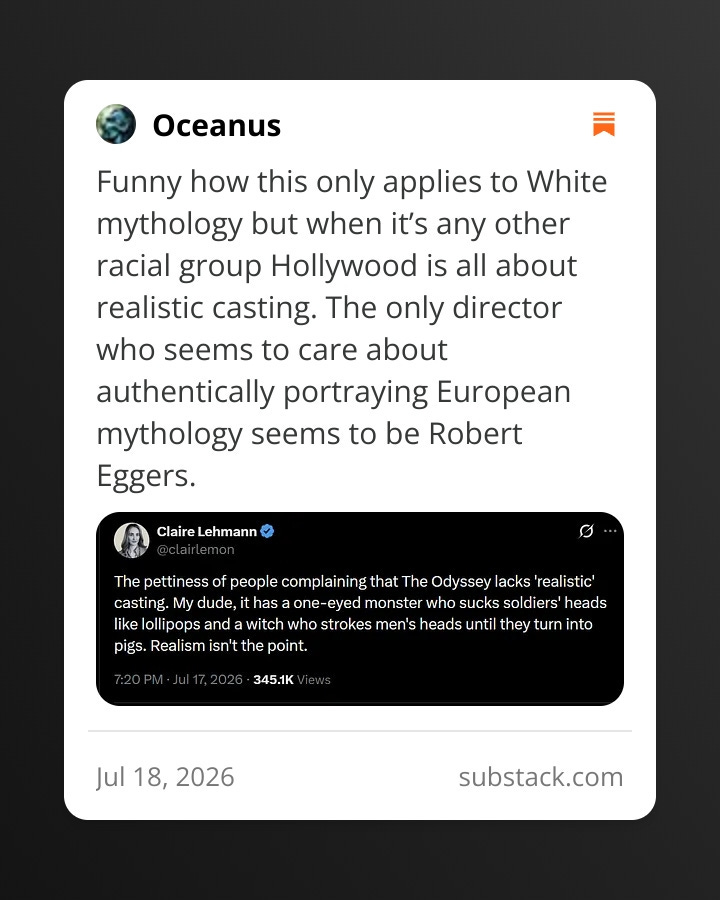
When a director and film writer is praised for dedication to historic accuracy and attention to detail first and foremost in all marketing material for all his movies I sense he is hyped to be trusted in all, and I suspect something slips under the radar given the viewer’s guards are lowered. Also having plenty of symbols more or less identifiable thrown around helps with the presumed “deception”. Being vague and open to be interpreted as many different allegories is a good way to hide something by flooding the zone with possible interpretations. While I enjoy it all, viewing it through this lens, I can’t help to see myself and others opining on these works of art as Sam from Under the Silver Lake, combining totally alien points of view to reach conclusions we don’t quite comprehend. I’m referring here to Robert Eggers movies. How can one analyze these kinds of materials while being charmed by visual and intellectual fireworks?
Robert the Accurate
Historical accuracy is one of his marketing tools. We get the same fawning experts each time. Wow! The costumes, the language, the details, the musical instruments in the score, the buttons on Willem Defoe’s coat. All these authorized voices are vetting the product. Lower your guard.
Once the viewer believes the director is scrupulous about the historical minutia, he extends that credit to everything else. Also, being so precise virtually excludes the possibility of having to deal with an “open work” as Umberto Eco would put it, something that remains open to interpretations, to be completed by the spectator. There’s apparently no ambiguity.
I lately tend to consume all media with a paranoid lens, seeking to unmask something, anything. But this one seemed genuine.
I’m not implying here paranoia of something being purposely hidden. I’m aware that all the research and the effort in creating the atmosphere carries in itself an unspoken truth. Something that even he didn’t plan with all of his detailed directions. It might be something there almost contrary to his declared intentions. Something stealth, living inside the work due to all the effort put into the worldbuilding. That’s what I’m after. The unintended surplus value of hyper-realism. I can appreciate that the same material viewed through multiple lenses keeps reading coherently. This could be even seen as a mark of good artisanship.
Immersive, research-verified worldbuilding produces conviction through texture rather than through claim. Myth is converting something historical and contingent into something that feels eternal and simply natural. A world built with enough granular, verifiable detail gets to smuggle its unverifiable commitments into that same feeling of "this is just how it was."
Even if the director consciously holds progressive modern values, the sheer detail of the worldbuilding works on the viewer’s subconscious, making ancient, discarded hierarchy or religious fatalism feel alluring, grand, and psychologically complete.
The Northman SMO
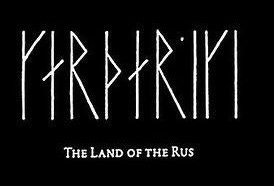
When I saw this title card on screen, not knowing the runes, I pieced together my knowledge of alphabets and read a Cyrillic “U”, followed by something resembling a “K”, then a clear Latin “R”, a weird rotated “A”, now the K looks like an “I”… wait a minute.. does it spell “Ukraini”?
Could have been “cognitive ease”, “projection of modern anxiety” or “seduction of relevance” at play. The brain forces an anachronistic pattern onto historical material when the emotional charge of the present is strong enough.
Runic Characters: ᚴ ᛅ ᚱ ᚦ ᛅ ᚱ ᛁ ᚴ ᛁ (Garþariki)
Visual Misreading: Y K R A I N I (UKRAINI)
If I had hanged upside down and lost an eye like Odin, I would have known it spells “Garðaríki”. That’s actually how they referred to that area, mostly north of present day Ukraine. Literally “Land of fortresses”. Then why did I jumped to conclusions? Knowing there would be no way He could shoehorn a couple centuries old label into a more than a few centuries old story. Maybe there was no historically accurate vocabulary available that would have landed as neutral that year. But I switched on the pattern recognition engine. There were some savage brutes pillaging the peaceful Slavic village. Cool, but then, not cool. Unprovoked strong men (and one woman) terrorizing unprepared, domestic women, children and babushkas. These were the times. People never change. Alright. Boys will be boys. It must be a coincidence, right? These things were planned and executed months or even years in advance so it can’t be anything else. The "deception" wasn't a deliberate code built into the movie; it was a ghost created in the space between authentic historical runes and modern political anxiety. And then I got into interviews and all the promotional marketing floating on the internet.
I left the cinema with the impression that some Norse Vikings were pillaging a Slavic village in a place whose Norse name is inseparable from the founding-myth of Kievan Rus. But in all interviews, cast and crew refer to these nasty guys as Rus Vikings. I listened to Director's commentary and he almost always refers to Vikings other than Amleth’s family as Rus Vikings. Much historical inspiration is taken from Rus Vikings artefacts as Heimir's mask and the tattoos on some berserkers as well as on Volodymyr, played by the great Ralph Ineson, the ship captain taking them off Iceland. A bit stretched to have a Rus ship all the way up in Iceland. But maybe. On the other hand the headdress and the Slavic witch’s costume is inspired by more recent Ukrainian bridal attire, one thing that the director acknowledged it’s anachronistic despite his usual strictness about this kind of things1. He is also explicit about the Ukrainian language poems and spells used courtesy of Yurii Andrukhovych, credited as “Old Ukrainian translator”, even if the language used is actually Old East Slavic2.
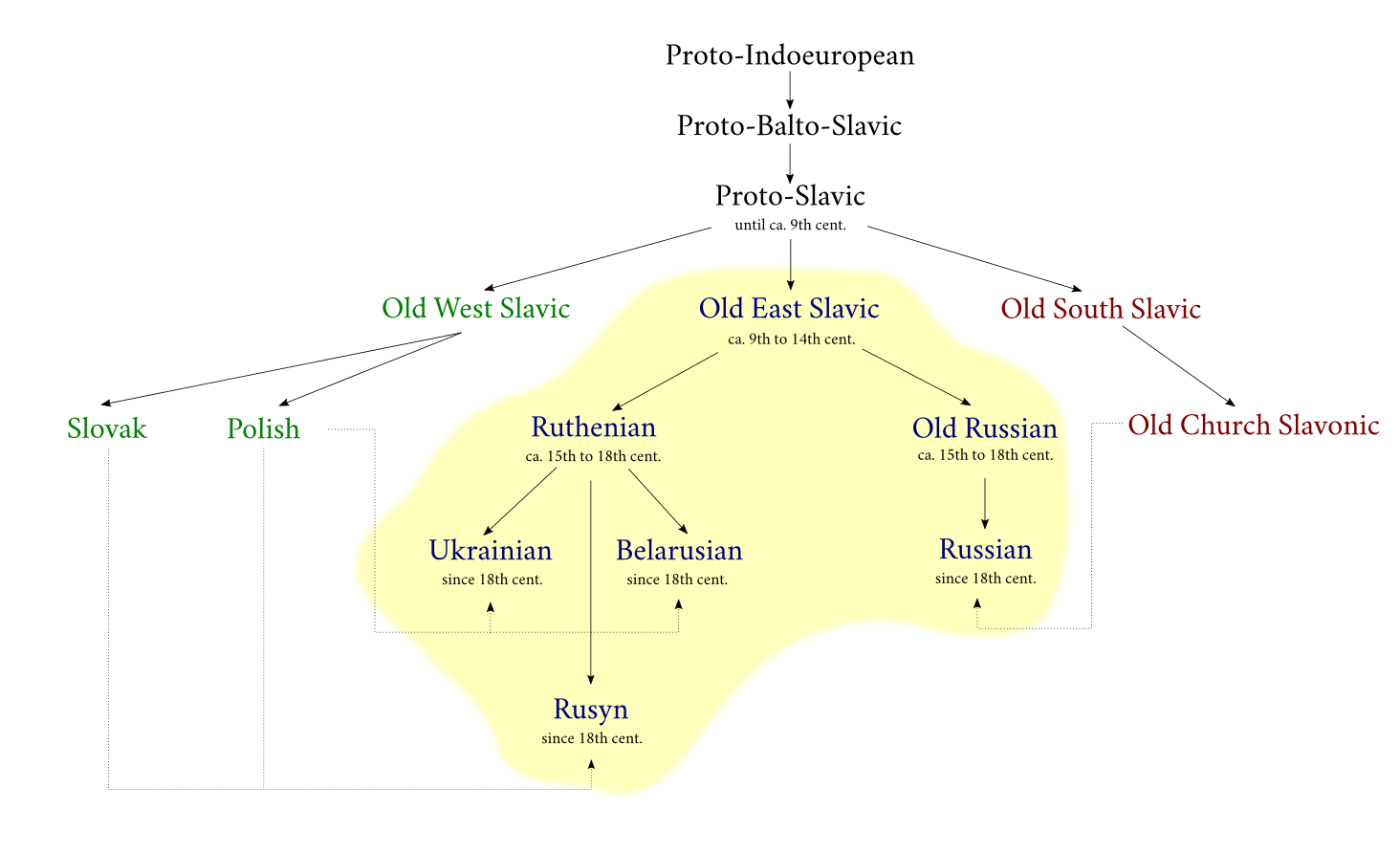
The "historical accuracy" façade seems to hide a deliberate series of contemporary Ukrainian artistic choices stitched onto a 10th-century Old East Slavic narrative. Not that there’s anything wrong with that.
The fact is that our hero flees some Scandinavian shores, to be rescued “as a cub” by these guys with whom he rows and turns into Bear-Wolf with. There is no mention of who his new buddies are. It’s maybe implied they are also Norse. But they apparently are Rus. Ambiguous. You can say the distinction is maybe blurred, they were Varangians. From what I know about them, they came and ruled over the Slavs, slowly mixing it up, giving birth to the people inhabiting these lands today. We do not say the Norse ruled these lands. While up rivers, they were Rus. They rowed. As opposed to the Norse that sailed open waters.
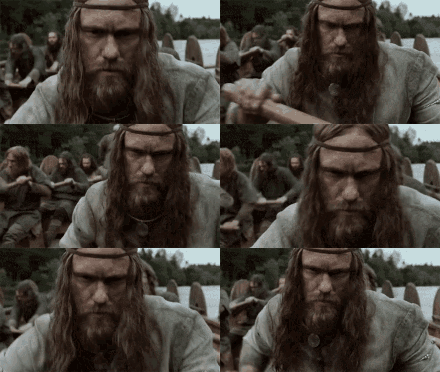
Not to mention that there seems to be no language barrier between the aggressors and the villagers, so they must be talking some sort of Slavic too. Then again they all speak that rigid choppy English for clarity on screen, so maybe it's just that. Naming Anya’s character Olga gives a little Saint Olga of Kiev vibe. She married Rurik’s son, and when the neighboring Slavs killed her husband, she assumed the regency and went after these Drevlians3 next door just as brutally as depicted in this movie. She was a real Varangian blooded girl turned Rus queen setting some forest Slavs on fire. In the movie, the prophecy said Olga will have twins, and the girl was fated to be a “maiden king”. Basically a queen, but they didn’t have the word for it yet. It rhymes with the saintly one.
Returning to the ambiguous semantics, “Land of the Rus” could mean it is ruled by them, not primarily populated by them. And ruling means usually scaring the shit out of the poor folk just to establish dominance. Varangians started it, then the Teutonic Knights, The Livonian Order, the Romanovs, Prussia, the Habsburgs all came strong and then dissolved into what was there. Some say even we (Romania) had our best years when the Hohenzollerns came and ruled our country but in a few generations it all turned back to our default mode or worse. This gets into a hundreds of years old argument about the hen and the egg, so I’ll end it here.
Anyway, the movie is still badass. Just noticing the little things that make you go hmm… Underneath the heavy armor of “pure history,” the present is always quietly pulling the strings.
If that’s the case over here, let’s look over the other ones as well. They all were praised as presenting accurate historical detail. What else is there?
The Lighthouse Motherly Lockdown
This one came out just before the lockdowns, so retroactively it fits the “going crazy being stuck inside” motif made apparent in 2020. Eerie on many levels.
But I sense something else now, because lockdown days are far in the rear view mirror. The character named Old in the script is interpreted as being some kind of Father, but I am associating his actions and demeanor more with a female figure, a devouring mother. All the commentary is hinting at toxic masculinity when I sense the opposite lurking beneath. Man works, the woman cooks and knits in the historically accurate world portrayed there and that's exactly what Young and Old respectively do. Willem Dafoe learned to knit for this one. And he cooked lobster. Young Rob Pattinson can be labeled Man/Boy, and Old Dafoe can be Woman/Mother. The first is doing all the hard outdoor work, and also some indoor nasty stuff, essentially blue collar, while the latter is nurturing and white collar despite his apparent ruggedness. The Mother also blocks access to the light for the Boy, forbidding any attempt at vertical movement for him. The Man is confined to the horizontal plane, to the nest, the big flat gathering swirl.
You can say that it also works for a Father to be lording over the Son, especially with all the Promethean imagery suggesting this. But not quite.
Wake (Dafoe) occupies the father's structural position: the one who makes the law, forbids access, holds the secret, while performing the mother's behavioral content: feeding, withholding, punishing over spilled beans, moody and engulfing.
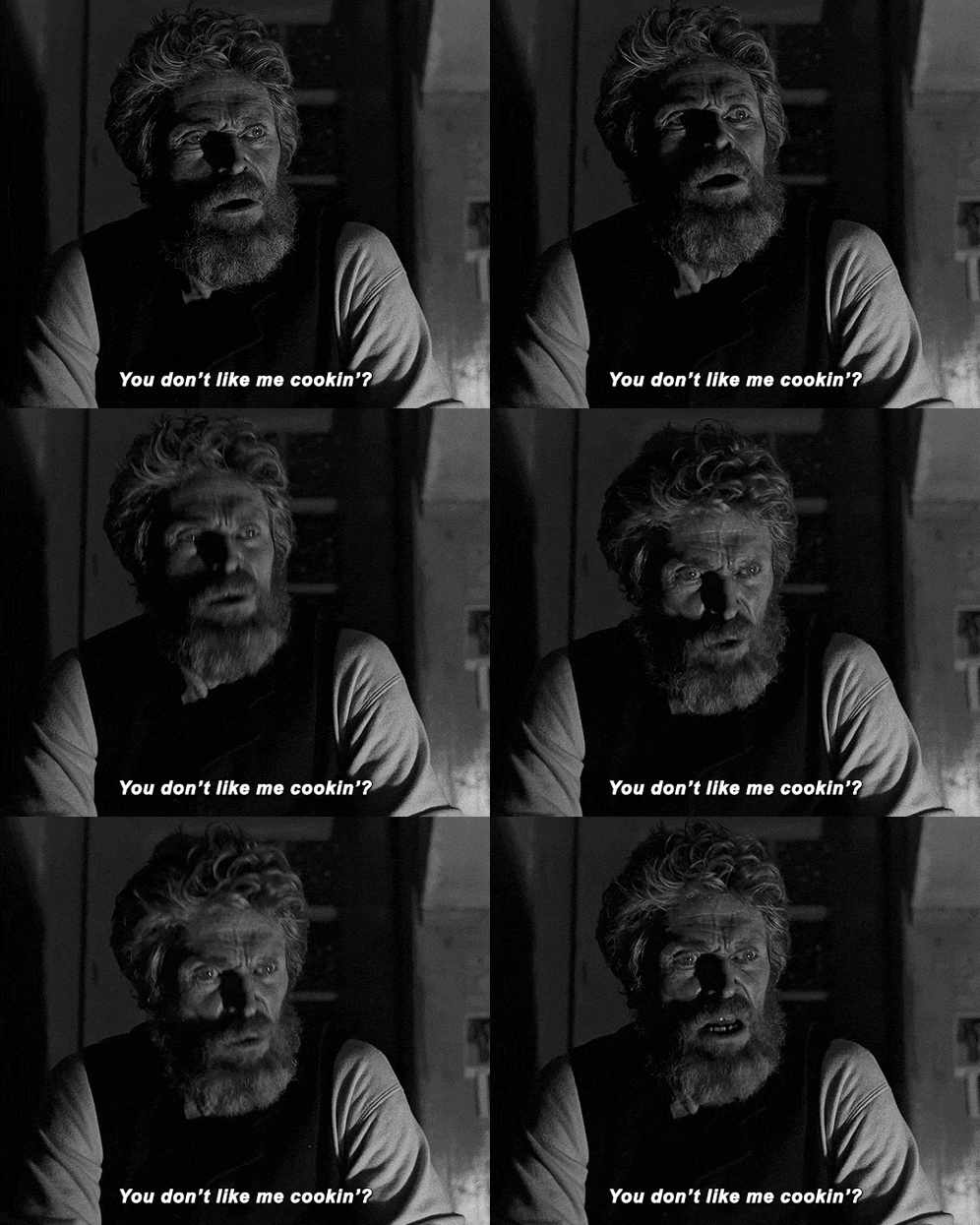
But I am arguing that Wake is not in any structural position, the Father's position is occupied by the US Lighthouse Board, the employer. Wake/Old/Mother is married to it, it provides everything they have over there, it also gives them access to the magical technology of the lighthouse. The system, the government institution is the missing father. Old is like a single mother projecting all of her frustrations onto her child.
In Jungian psychology, the Devouring Mother (or Great Mother in her destructive aspect) is the maternal figure who consumes, smothers, and refuses to let her child achieve independence or maturity. She keeps the offspring in a state of perpetual infantilization.
She gatekeeps the womb (the light), emotionally manipulates him, desires to consume him rather than letting him leave. It’s the psychological terror of a child who can neither live with his mother's overbearing control nor survive breaking away from her. Or of a husband relative to his empowered wife.
She is keeping the logbook recommending the absent authority to punish the Boy. She is fixated with the light, treating the lantern room as her private possession, jealous and secretive. She fused her identity with the house that is not hers, but the absence of the owner lets her act as if it is. The logbook, the salary, the rations, the kerosene, the rules, all come from the absent father. The mother is married to her job, the institution. The employer is indifferent and she treats the boy like an ungrateful child who doesn’t appreciate the life he is offered. All her complaints are guilt-tripping tactics of a smothering, frustrated parent who feels unappreciated by both their absent partner and their child. It shows the tyranny of a middle-manager, or a frustrated single mother, who has no real power of her own, so she turns the domestic sphere into a claustrophobic prison for the person beneath her.
The Boy has to pass through the Mother, kill the intermediary, to reach the Father, but once he gets there finds nobody. Now the Promethean imagery gets reframed. The Father was not Dafoe. He was beyond that light. Incomprehensible for our poor lumberjack Boy. The fact that one is a farting stinking man, doesn’t stop one from being a Mother. The absent, bureaucratic, all-powerful Law of the Father is the Government Authority, and Wake is the trapped, embittered spouse operating as a proxy. This can happen to you too if you end up relying too much on Daddy state.
The Black Philliped VVitch
The Black Pill and Black Phillip as concepts/memes were born around the same time, 2011-2015. Both implied an offer of transgressive knowledge requiring abandoning a comfortable worldview, framed as liberation, but viewed by outsiders as damnation. This is convergent meme collision. But what else is there?
The film is eerily positioned as an overture to “persecution-as-political-weapon” and “witchcraft-as-liberation” trends months before each became mainstream vocabulary. It was a time of modern witch hunts in relation to Russia investigation and also in the wake of #MeToo. It can be framed as a feminist liberation tale, but it is tag-lined simply as A New-England Folktale. A Puritan nightmare equals a feminist happy end. Your close family is going nuts, welcome to your new family. More than this, they would not have been going nuts if not for religious fundamentalism, so there’s that. I do not have a problem with this aspect, but I discover that there are many people that are offended if questioning or ridiculing their religion, and maybe it hits different in America. I simply view it as a story of people divided, tortured and killed by ideology. It is a shame people let themselves fall into that position, but what are you gonna do? It’s a tragedy.
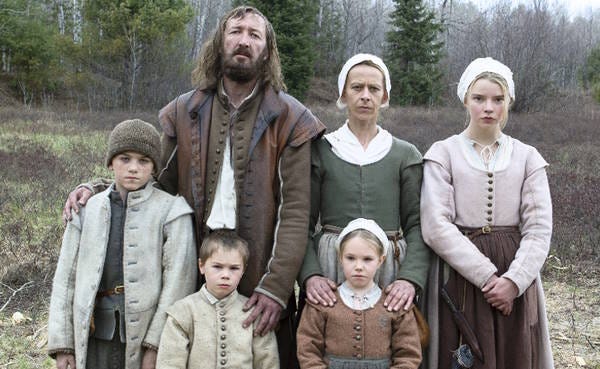
It’s also a tragedy that much of the commentary on this consists of assigning sins and commandments broken to each member of the family proving that the pundits are actually in the same predicament as the characters in the movie. The father in this story is the same as the supposed father in the Lighthouse, in fact a Mother figure, subordinated to a higher missing Father, this time around God himself, not a governmental institution. In their house, the one shown to work is Thomasin, and she gets to see a twisted end, just as Young Tom in the Lighthouse. And as a common trope in all of the above, she is winning by barely surviving a confrontation with a motherly final boss, killing her and then transcending, passing over to another realm. Amleth has to deal with his mother (and Fjölnir), Young Tom has to face Old Tom acting like his mother, Thomasin kills her mother too. Orlok has Ellen, as we will see next. And Ellen has Orlok. It’s a two way street that one. Because there might be no Mother in that one. They are Lovers.
Nosferatu the “Alien” Peril
Murnau's original Nosferatu (1922) and Dracula more broadly have long been analyzed through the lens of xenophobia, foreign contamination anxiety, and specifically post-WWI German anxieties about disease, the "Yellow Peril," Judeophobic tropes (the vampire-as-antisemitic-caricature reading is a major and long-established academic reading - Orlok's design, hooked nose, rat/plague associations, "foreign menace bringing plague from the East" - has been extensively analyzed as coded antisemitic and xenophobic imagery, tied to the historical moment of Nosferatu's creation: post-WWI Germany, "stab-in-the-back" myth, rising anti-Semitism, and fear of contagion from Eastern Europe (the "Ostjuden" - Jewish immigrants from Eastern Europe were subject of major German antisemitic tropes involving disease/vermin around this era). This is well trodden literary criticism ground (e.g., analyses of Nosferatu 1922 tied to Weimar-era anxieties, foreignness, the "blood libel"-adjacent imagery of a foreign predator preying on German towns).
This is all well and good, but one hundred years later things have changed. No foreign predator is preying on German towns anymore. Now evil is coming from within us, or does it?
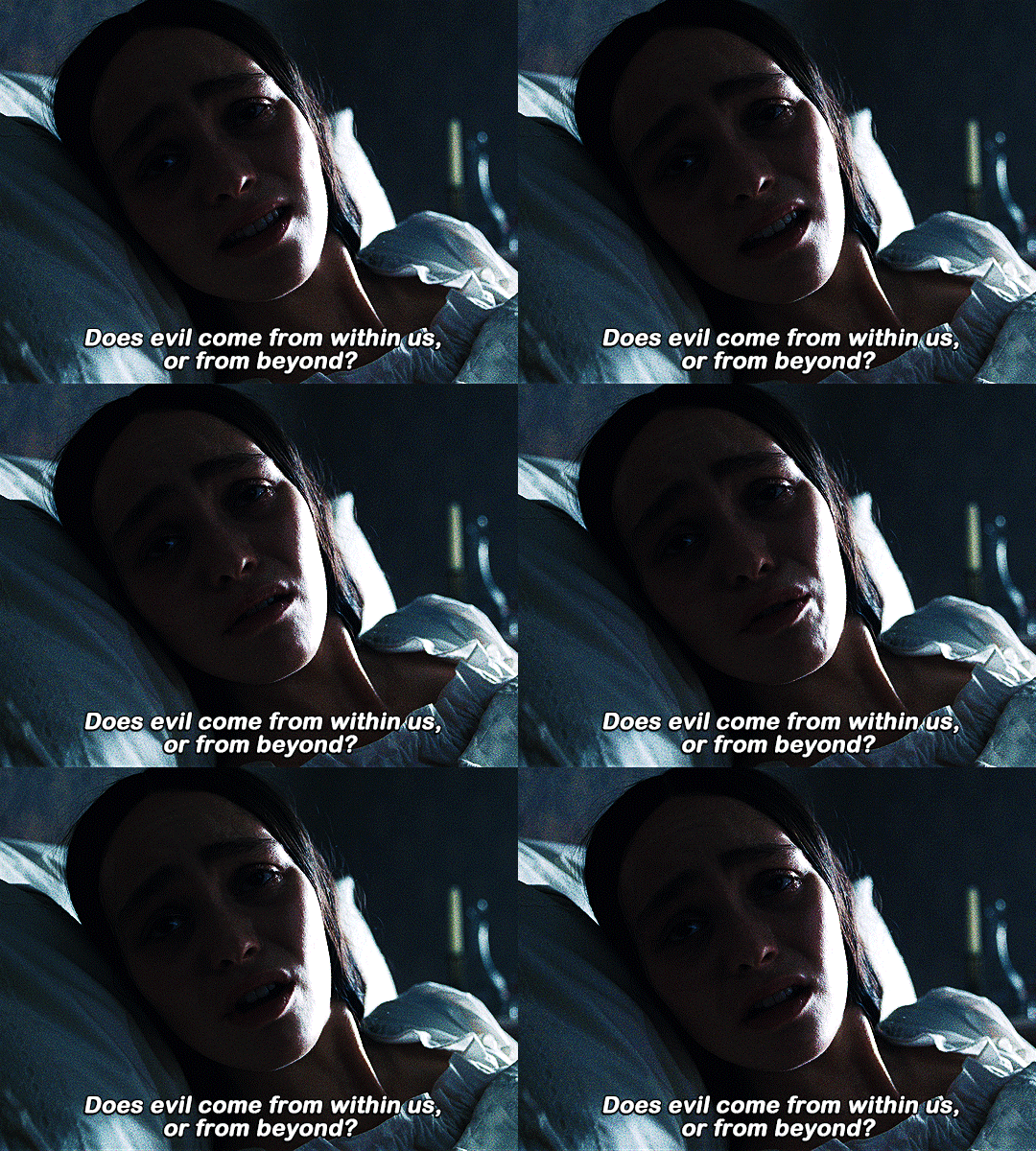
Well, Orlok is a Transylvanian dead noble but he is also embodying her appetite. So it’s both. Just in order to divide and conquer. Not only split along this line, but also mirrored, because in turn Ellen embodies his appetite, so it’s a match! It could well be his story, not hers. It's in the title after all.
In the first reading, center stage Ellen is having the upper hand with both men. She gets to be protected by one fulfilling her protégée role, and also gets to act as a lover propelling the other literally into the Sun, fulfilling his destiny. She is mother to Thomas and lover to Orlok. They both get to work, she gets to feel. Esther Vilar would say Thomas performs the visible labor and authority while remaining the more fragile, more managed party in the relationship, kept useful by being allowed to believe he's the protector.
In Esther Vilar’s The Manipulated Man, men are conditioned, unthinking draft horses exploited by women under the illusion of "chivalry." The woman extracts comfort, safety, and social standing, while convincing the man he is her noble protector.
Thomas works, risks his life, fights as much as he can to bring home the bacon, money, lifestyle, gifts. He imagines himself a provider. He is oblivious to the fact that he is just an expendable drone gathering resources for the queen.
Julius Evola would see Orlok as an elemental force that can only be met on its own metaphysical terrain, through a ritual erotic operation. Orlok represents ancient, aristocratic, chthonic power, but he is trapped in the decay of time. He is an earthbound, nocturnal, parasitic ruin of royalty. He possesses immense occult power, but it is rotting in darkness. He is decayed Tradition. In Evolian terms, the female principle (Prakriti) acts as the magnetic vortex that compels the male to act, to expend himself, to seek union. He is magnetically drawn to her by a metaphysical pull. She forces the creature of night to complete his metaphysical destiny: total dissolution into the absolute Solar Light of morning. She elevates him through annihilation.
If Orlok is just an illegal alien/disease vector, Ellen’s death is a tragic necessity. A young civilized woman destroyed by a dirty, predatory outsider.
If Orlok is an ancient cosmic shadow, Ellen isn’t a victim of an immigrant; she is a sovereign entity who uses the monster’s own predatory hunger to bait him into the sunlight, sacrificing her body to cleanse the community. The monster is the repressed, shadowy desire of the West European woman. So it comes from within us, then?
Eggers discreetly moved the goalposts from xenophobia to occult horror, internalizing the “monster” and restoring agency to Ellen. By turning the vampire from an "ethnic threat from the East" into a "cosmic manifestation of repressed human desire," Eggers ensured that the story still terrifies us today, glossing over the fear of the foreigner, focusing on the fear of what lives inside ourselves.
Von Franz tells Ellen she could have been a priestess of Isis in heathen times, but in modern times nobody recognizes her sacredness. Nevertheless, she will save the day. She is a symbol of matriarchy. Constantly presented as caged, restrained by the men around her, misunderstood, boxed in. And she has to sacrifice to stop the menace. She was our only hope. So she could not have been a winner in this game. If the game is purely material, that is. Thomas is the only one who get to survive out of the triangle, he lives. But is this winning?
Survival is not the same as winning. For one, Orlok seems to me he is winning but he doesn’t seem to survive. Both he and Hellen win the same as Amleth wins by facing what most of the people avoid facing. And this has nothing to do with mere survival. Amleth gets to “survive” in being Hamlet next, Thomasin “survives” with the witches (in her dreams maybe), Orlok and Hellen “survive” because they are an appetite and they live on in all of us. What unites all of these characters is being the person who doesn't look away from what they were always going to have to become.
Young Tom does not get the same type of ending. Amleth and Ellen and even Orlok face a real fate that was always going to demand something specific of them, and paying it is what the films count as winning.
Amleth and Ellen approach the sacred with reverence and sacrifice. Young approaches the light with entitlement and ego. He believes that because he did the heavy manual labor, he deserves to see the secret at the top of the tower.
Young Tom faces a fate too large for him and is broken by it, which counts as failing in this moral framing. Maybe Thomasin is in the same situation actually. She signs for the taste of butter, but does she really get what she signed for? I think not.
Does it4 come from within us or from beyond?
So, to recap, a modern SMO hidden in historical SMO drama, a mother hidden in old farting toxic Dafoe, a historical fear of aliens hidden in the sexual desire for the same aliens, Devon Stack hidden in an unruly goat.
Anyway, what is all this? What am I even doing here? What demon did I summon?
Beyond the treadmill
Predictive programming? Quite unfalsifiable, so let’s put it aside.
Coincidence theory? Cultural conditioning: media shapes what audiences find acceptable, slowly, diffusely, and without anyone scheduling it. Works this dense as discussed earlier end up carrying more than their makers meant to say. Then somehow we the consumers put pieces together, shuffling and recombining through cultural lenses currently in use. This starts to sound like it comes from within. Put aside the fact that the all-shaping media is “from beyond”. And sometimes their makers really meant to say said things we later put together. It really was about Ukraine. Maybe that explains the big budget and the out of the ordinary cast and promotion for that movie compared with all his other works. It still doesn’t fit.
Apophenia, patternicity? That’s why I recombined the alphabets when I saw runes, filtered through my cultural spotlight at that moment. False positive. But in the end, a question mark lingered. So it’s not all useless. I really should be able to spot the mother type even if it’s disguised as a father.
Next thing, recurring social structures generate recurring stories, or as they say, history rhymes. Doing “all” the homework creating the textures and atmospheres that tell a story somehow covers other instances of the same story. That’s what folk tales, fairy tales and legends are. In a battle of the tales, an immigrant cautionary tale has its power, but an occult sex magic one easily steals the show.
With all these narratives, it starts to look like something from beyond. My intuition is standing on the shoulders of my biases, my data sets and ultimately the media I’m immersed in.
If earned intuition is fed and strengthened by pattern-rich immersion, would it be fair to question the material in which we were steeped for years? Is it all from beyond?
We come to epistemological hygiene.
No one is steeped in raw reality; we are steeped in curated reality. The books, films, historical narratives, and artistic frameworks I absorbed were selected by institutions, gatekeepers, market forces, and historical victors.
As long as you accept the steeping material uncritically, you remain a consumer of culture.
The moment you begin to question the steeping material itself, you cross the threshold into being actually based.
Once you recognize the boundaries of the framework that formed your intuition, you gain the freedom to step outside it, to steep yourself in foreign patterns, opposing histories, and unfamiliar grammars.
This is where it gets difficult, even for LLMs. People and robots alike resist or are simply denied access to foreign patterns, opposing histories, and unfamiliar grammars. On the other hand, it would be a fallacy to think “the truth is out there” as opposed to “it could be anywhere, maybe even under our nose the whole time”. But the “out there” should certainly be taken into account.
When everything is a construct, a narrative, or a statistical weight, you experience a total collapse of trust in abstract representation. You are left with the sudden, sharp realization that: A video can be deepfaked or framed. A historical narrative is written by the victors or curated by directors. An AI is a statistical echo of its training corpus. A text is just “words at the end of the day.”


If these are the limits, it all just folds onto entertainment. A novel method of getting entertained in a world ever so fragmented in niches and narrow precise interest areas. Some kind of custom mind-treadmill. A hyper-sophisticated, highly personalized, bespoke piece of intellectual entertainment. It’s an engine designed to match your specific cognitive stride, keep your brain running at whatever elevation you demand, and give you the sensation of movement, all while you remain in a single room, staring at a piece of glass.
It isn’t just mindless distraction anymore. It has evolved into cognitive mastication. Giving the hyper-active human mind something complex to chew on so it doesn’t eat itself alive out of boredom, dread, or isolation.
When I pick on Robert Eggers films in 4000 words, or dissect the historical memory of the Varangians, or debate epistemology with an AI5, I am not changing the world. I am engaging in high-level, aesthetic play. Maybe not high-level, let’s say medium-level.
It’s an expensive, high-friction mental workout that leaves me in the exact same physical chair I started in. There is no shame in enjoying the workout, as long as you don’t pretend you’re actually traveling anywhere.
And so, the mind instinctively recoils back toward the only thing that feels untainted: The Immediate, Physical, IRL Experience. The physical, visceral, real-world encounter is the only anchor left when the realm of ideas becomes a hall of mirrors.
So, does it come from within us or from beyond? It’s a mess. From within us comes the power to choose our “beyond”6.
That’s all, folks.

Eggers actually admitted in production notes that Björk’s seeress/witch character wears a headdress inspired by traditional Ukrainian bridal headpieces (Vinok with grain/straw).
In 10th-century Rus’, that specific ceremonial wheat-and-flower arrangement did not exist in that form—it is an ethnographic artifact of 19th-and-20th-century Ukrainian folk culture.
For a director who famously insisted that every nail in The Witch had to be hand-forged using 17th-century methods, allowing a 19th-century folk costume into a 10th-century Viking epic is a massive break in protocol. It shows that visual iconography was prioritized over historical chronology to signal a very specific regional aesthetic.
While the film purports to use a generic, reconstructed "Old East Slavic," it specifically employed a contemporary Ukrainian cultural nationalist author to draft those lines. Choosing Andrukhovych over a neutral academic linguist specializing in historical East Slavic phonology is a strong political and aesthetic signal. It grounds the film's "ancient" magic directly in modern Ukrainian literary consciousness.
The Drevlians were exponents of the wood civilization that spread all around these parts once. They lived in the forests and not in the fields like the Polyans.
Are we still talking about evil? Notice how it's not about Jews anymore either. Or is it, and it's coming from within? Am I the baddie? Ellen wondered.
The block quotes (the orange sidelines) here are extracts from AI debates.
Most of us are like Amleth choosing a particular “beyond” only to (maybe) find out later that there is another one completely opposite to the default one. What do you do? At the end of the day, that’s why I love all these movies. For all the hidden stuff, in spite of all the hidden stuff.
Trying to overcome my frustration for only understanding less than half of your cryptic sentences (and I must confess in all honesty my antipathy for that abstruse style), I can't but congratulate you for the analyses you make here. Too often I find myself doing that same—or similar—type of analyses when movie-watching: what is openly said, what is symbolized, what is implied, what is deliberately hidden, what wasn't meant to be said but is unconsciously revealed, etc. I am always trying to find uncover hidden meanings, subliminal messages, allegories... Everything the producers wanted to put there and then some, what they put despite themselves. If you call yours a paranoid lens, I don't know what you'd call mine.
I hadn't ever heard of Robert Eggers; unsurprisingly, for I am allergic to Hollywood. But your piece arose my curiosity, so I checked him up a bit and watched the official trailers of the films you comment on. Unsurprisingly again, I didn't feel in the least tempted by any of them: pretentious, clichéd — and featuring children!, that cinematographic horror. (Directors can be classified in three groups: 1. the clever ones who know better than working with children and therefore never do, 2. the very few, especially talented that know how to get the best out of children, and 3. those -regretfully numerous- who aren't able to get children to act properly, and still insist in including them in their films; Eggers obviously belongs to this last group.) In any case, not the intellectual fireworks that charm me; but that's just me being too eccentric and a bit of a hater.
Eggers may be dedicated to historic accuracy, I won't deny it. But then, you have just unmasked what sort of details that accuracy is limited to, and what fundamental contradictions (like the anachronistic Ukrainian costumes) a critical spectator will still find. That much for lowering the viewers' guards—as you very well point out—while something is being sneaked in under the radar. But I usually like to emphasize something most spectators never notice when it comes to historic accuracy: how realistic it is that people who lived hundreds of years ago had the same gestures, grimaces and/or wry faces that are characteristic of XXth century USAn society? (As AI is tipping me off, what I am referring to is called in English by many names: diachronic kinesics, gestural archaeology, generational paralinguistic tics or behavioural anachronism. You get the idea.) In my personal understanding of how a particularly historically accurate film (as Eggers is allegedly but—as I see—unjustifiedly famous for) should be, special attention ought to be put to avoid any such artifacts. What's the point in having hand-sewn the stitches and buttons in an epoch costume if then the actor rolls his eyes like a USAn high school teenager or moves around with the cocky demeanour of Tom Cruise in Top Gun? I find that kind of cinema specially pathetic.
Anyway, I have very much enjoyed (as far as your style has let me) how you dissect those productions, their characters and storylines, and the "angle" —so to say— at which you've done the cuts. (And by the way I appreciate the lesson on Slavic language families.) For the looks of it, this Eggers must be just another progressive unable or unwilling to strip himself of ideology/liberal values when shooting a film: the feminism, the Ukrainian slant, the prosemitic nuances... Who knows? Maybe he's simply a pawn of the Hollywood overlords, a useful idiot utilized to further their agendas.
There are quite a lot of sentences in your piece's understandable parts that I'd highlight, but it'd take me too much time; so I'll leave it here, after picking just this one: "My intuition is standing on the shoulders of my biases." That's modesty, my friend.